

When it comes to email marketing platforms, ActiveCampaign vs AWeber represents a choice between two established services with significant differences in performance and capabilities. Notably, ActiveCampaign scored first among all platforms with a 94.2% deliverability rate, whereas AWeber trails with deliverability rates ranging from 89.4% to as low as 78.67% according to some reports.
Although AWeber has been around longer (founded in 1998) compared to ActiveCampaign (2003), the latter has emerged as a comprehensive marketing automation platform combining email marketing, sales automation, and customer experience tools. While AWeber features stand out with approximately 700 email templates and a robust free plan supporting up to 500 subscribers and 3,000 monthly emails, ActiveCampaign offers 125+ responsive, modern-looking templates and typically provides better value overall. AWeber pricing plans might appeal if you have a smaller email list; however, ActiveCampaign maintains its position as a leader in ensuring marketing emails reach recipients’ inboxes.
Whether you’re comparing AWeber pricing plans with ActiveCampaign, or exploring all-in-one solutions like Systeme.io vs. AWeber for your specific needs, this comprehensive comparison will help you determine which platform better aligns with your marketing goals and budget.
Comparison Table: ActiveCampaign vs. AWeber
| Feature | ActiveCampaign | AWeber |
| Deliverability Rate | 94.20% | 89.50% |
| Email Templates | 250+ modern templates | 600+ templates |
| Automation Capabilities | 900+ pre-built automation recipes | Basic automation templates |
| Split Testing | A/B/C/D/E testing | Up to 3 groups (A/B/C) |
| CRM Functionality | Built-in CRM with pipeline management | No native CRM (third-party integrations only) |
| Native Integrations | 970+ integrations | 700+ integrations |
| Starting Price | $15/month (1,000 contacts) | $15/month (500 contacts) |
| Free Option | 14-day trial | Free plan (up to 500 subscribers) |
| Monthly Email Sends (Basic Plan) | Not mentioned | 3,000 (Free plan) |
| Customer Support | 24/7 live chat and email | 24/7 live chat, email, and phone |
| User Interface | Modern, workflow-based navigation | Basic, list-centric interface |
| Learning Curve | Steeper but intuitive | Beginner-friendly |
| Founded | 2003 | 1998 |
| Best Suited For | Advanced marketing automation needs | Basic email marketing needs |
Ease of Use: Beginner-Friendly vs Feature-Rich
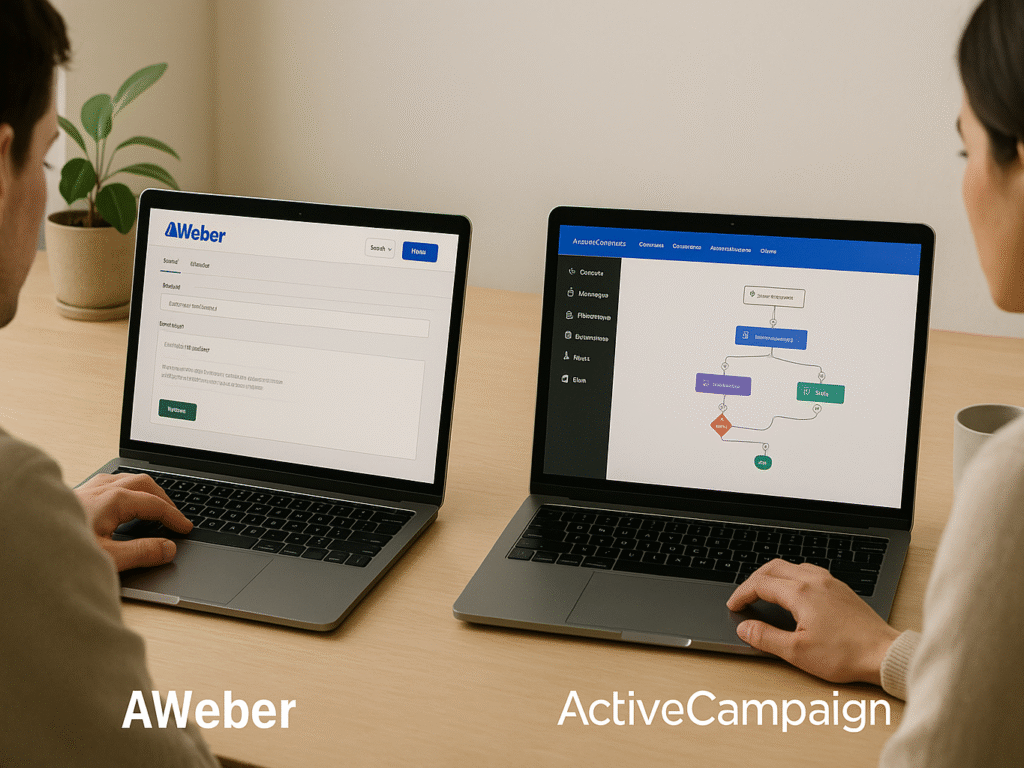
The battle between ease of use and powerful features takes center stage in the AWeber vs ActiveCampaign matchup. Despite having substantially more features, ActiveCampaign surprisingly offers a more intuitive user experience than its seemingly more straightforward counterpart.
1. Dashboard Navigation and UI Simplicity
In terms of interface design, ActiveCampaign presents a fast and well-organized backend that makes navigation remarkably straightforward. Its neat organization creates an excellent user experience, allowing you to manage lists and subscribers with flexibility and efficiency. Creating campaigns feels intuitive as you can easily check previous and next steps during the setup process.
- ActiveCampaign enables users to manage multiple lists with tags, thereby reducing duplication.
- You can view automation flows visually for easier edits and tracking.
- Built-in split testing is available during campaign creation for better performance.
Conversely, AWeber’s interface can sometimes feel confusing despite its reputation for simplicity. Many users report that essential options, such as reusing campaigns or selecting sender addresses, are unnecessarily hidden. Furthermore, AWeber’s naming conventions can be perplexing, referring to regular newsletters as “Broadcasts” and email automations as “Campaigns”. The platform primarily organizes around subscriber lists, making it more challenging to navigate to campaigns and automation features.
2. Learning Curve for New Users
AWeber caters specifically to beginners in email marketing with a straightforward approach that avoids overwhelming users with complex features. Suppose you’re evaluating AWeber’s comprehensive feature set and genuine user feedback. In that case, you’ll find it particularly suitable for small businesses, solopreneurs, and content creators who require simple and reliable email marketing solutions. The platform provides abundant tutorials and instructional videos to guide newcomers through its features.
ActiveCampaign, meanwhile, offers a more comprehensive set of features that naturally present a steeper learning curve for new users. Nonetheless, its intuitive visual builders and well-organized interface make advanced marketing strategies accessible even to those with minimal technical expertise. The platform essentially transforms the learning process into a rite of passage for marketers aiming to master sophisticated functionalities.
3. Workflow-Based Navigation in ActiveCampaign
A standout advantage of ActiveCampaign is its workflow-based navigation menu, something AWeber noticeably lacks. ActiveCampaign’s visual automation builder makes it exceptionally easy to visualize complex workflows. You can add actions like “wait,” apply “if/then” logic, and set up triggers to shape each contact’s journey.
The platform excels with its library of over 900+ pre-built automation “recipes” that you can implement immediately with minimal configuration. These automation templates cover a range of use cases, including lead nurturing, abandoned cart recovery, and event marketing. Additionally, ActiveCampaign allows A/B/C/D/E testing of entire workflows to determine which sequence drives more engagement or conversions.
- AWeber supports basic automations, such as welcome emails and follow-ups.
- Automation is built around list-based subscriber actions (opens, clicks, purchases).
- No visual automation map, users rely on dropdown rules.
- Limited to A/B testing only; no multivariate workflow testing.
Both platforms in the ActiveCampaign vs AWeber comparison strike different balances between functionality and accessibility. AWeber emphasizes simplicity for those starting their email marketing journey. At the same time, ActiveCampaign provides sophisticated tools wrapped in a surprisingly user-friendly package. Your choice ultimately depends on whether you prioritize immediate ease of use or long-term marketing capabilities.
Email Automation: Visual Builder vs Basic Campaigns
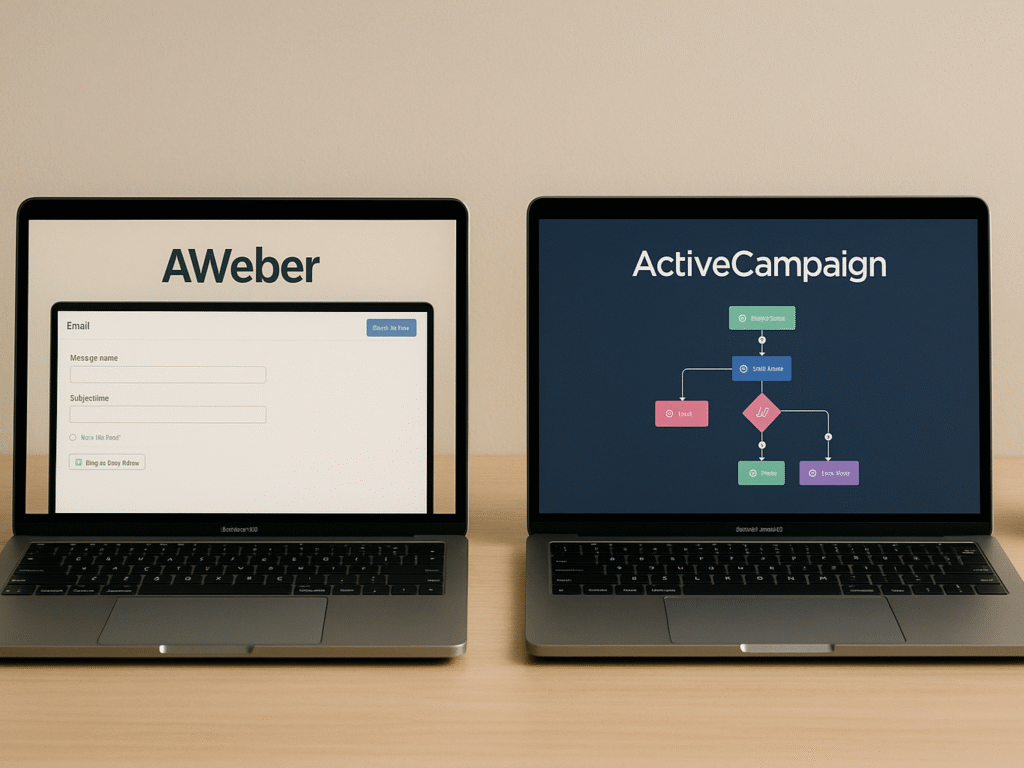
Email automation capabilities reveal perhaps the most significant divide between these two email marketing platforms. While AWeber offers straightforward automation tools, ActiveCampaign delivers a more robust visual automation ecosystem that transforms how marketers craft customer journeys.
1. Automation Recipes: 900+ vs Limited Options
The gap in automation resources is substantial between these platforms. ActiveCampaign boasts an impressive library of over 900 pre-built automation “recipes” covering various business needs. These templates help you quickly implement sophisticated workflows for welcome sequences, abandoned cart reminders, lead nurturing, and customer onboarding without starting from scratch.
In contrast, AWeber offers basic automation templates, primarily focused on essential email sequences, such as welcome emails, lead magnets, and thank-you messages. Though limited in scope, AWeber’s automation builder is designed for beginners who want simple automation without a steep learning curve.
2. Conditional Logic and Triggers
Both platforms offer conditional logic, yet with notable differences in complexity. ActiveCampaign enables you to create sophisticated, multi-step workflows with conditional logic, delays, and splits that dynamically adapt based on subscriber actions. You can trigger automations from dozens of conditions, including site visits, purchases, and custom events.
AWeber’s approach is more straightforward; you can set up automations based on specific subscriber interactions, such as opening a message or clicking a link. For instance, when a subscriber clicks a link in your message, they can be tagged to receive another workflow. Initially, this simplicity makes AWeber accessible, but it may be potentially limiting for sophisticated marketing needs.
3. Split Testing: A/B vs A/B/C/D/E
The split testing capabilities differentiate these platforms. ActiveCampaign offers comprehensive A/B/C/D/E testing, allowing you to test up to five different elements per email or landing page. Beyond just testing subject lines, ActiveCampaign enables you to test entire workflows to determine which sequence drives more engagement or conversions.
Conversely, AWeber offers more basic split testing functionality with up to three groups. You can test different subject lines or message content to increase subscriber response rates, sending the winning version to the remaining segment. While functional, this capability lacks the depth of ActiveCampaign’s testing options.
4. Behavioral Targeting Capabilities
Behavioral targeting represents another area where these platforms diverge significantly. ActiveCampaign excels with its ability to:
- Monitor registered visitors on your website and adapt email campaigns to their behavior.
- Send targeted emails based on specific page visits (like sending cheesecake recipes to someone who viewed a cheesecake page)
- Create follow-up sequences based on engagement with previous messages.
ActiveCampaign’s behavioral tracking is more sophisticated, enabling event tracking that monitors specific customer behaviors, such as purchases or form completions. These insights let you tailor follow-up communications based on real-time actions.
AWeber offers some behavioral segmentation by tagging subscribers based on their interests and interactions. Still, its capabilities remain considerably less developed than ActiveCampaign’s comprehensive behavioral targeting system.
Fundamentally, your choice in the ActiveCampaign vs AWeber debate comes down to automation needs: AWeber for simple, straightforward automation workflows, or ActiveCampaign for sophisticated, behavior-driven marketing campaigns.
AWeber Honest Review: Pros, Cons & Features Compared (2025 Edition): Get the complete breakdown of AWeber’s strengths and weaknesses. Our detailed review covers pricing, features, deliverability rates, and real user experiences to help you make an informed decision about this email marketing platform. Read Full AWeber Review.
Email Templates and Design Tools
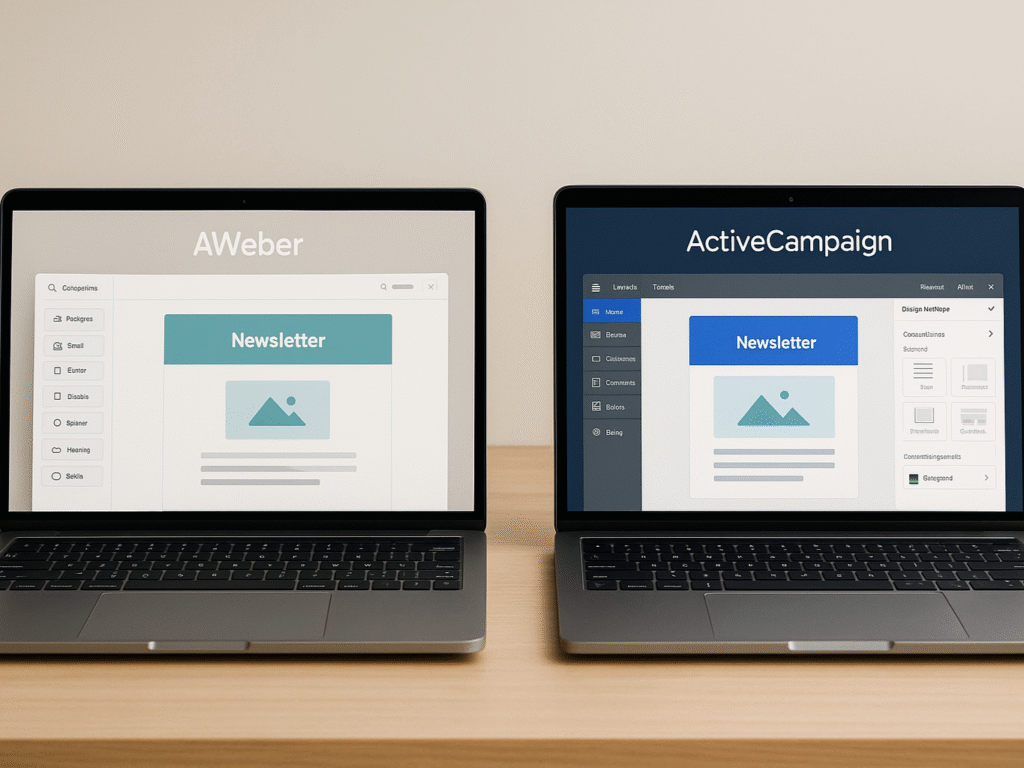
Beyond automation capabilities, the aesthetic quality of your emails has a significant impact on campaign performance. In this area, AWeber and ActiveCampaign offer distinctly different approaches.
1. Template Count: 250+ vs 600+
The template library size represents a clear distinction between these platforms. AWeber boasts an impressive collection of over 600 email templates, providing users with abundant options for various campaign types without requiring design skills. This extensive selection makes it easy to find designs that align with your brand messaging.
Conversely, ActiveCampaign offers approximately 250 templates, which is less than half of AWeber’s offering. Nevertheless, ActiveCampaign focuses on quality over quantity. Its templates feature modern, responsive designs with clean aesthetics. Many users find ActiveCampaign’s templates more contemporary, whereas AWeber’s larger collection sometimes includes outdated designs that may require more modernization.
2. Customization and HTML Support
Both platforms support template customization, albeit with different approaches, and understanding ActiveCampaign vs. AWeber pricing helps determine which customization features offer better value. When comparing design flexibility across platforms, AWeber alternatives like ConvertKit and Mailchimp also offer unique customization features.
ActiveCampaign’s editor stands out for its intuitive interface and flexibility. It allows full layout control, rich customization, and includes an HTML builder with real-time preview for users who are comfortable with coding.
AWeber’s editor feels less flexible but offers paid customization services starting at $29. While it supports HTML, the platform emphasizes pre-built templates and professional design assistance for branding consistency.
3. Mobile Optimization and Preview
Mobile responsiveness is crucial, with approximately half of all emails now opened on mobile devices. AWeber makes all emails created with its drag-and-drop email builder automatically mobile-responsive. It ensures content, images, and buttons adjust appropriately for smaller screens. Multi-column layouts intelligently convert to single-column formats on mobile devices.
Similarly, ActiveCampaign automatically optimizes all emails for mobile viewing. Its platform includes preview functionality that allows you to check how your emails appear on both desktop and mobile devices before sending. This feature helps identify any formatting issues that might affect the user experience.
4. Dynamic Content and Personalization
Personalization capabilities reveal significant differences between these platforms. ActiveCampaign excels with robust dynamic content features that allow you to:
- Display different content blocks based on subscriber data
- Implement conditional content using tags, merge fields, or segmentation data
- Swap images and media based on subscriber preferences
- Customize email subject lines and preview text for different segments
- Modify CTAs according to each recipient’s journey stage
AWeber offers basic personalization features, primarily centered on merge fields for adding subscriber details, such as first names. The platform does support some dynamic content functionality, allowing you to create emails where text or images change based on subscriber tags. According to Experian research cited by AWeber, personalized emails generate six times higher transaction rates.
Both platforms in the ActiveCampaign vs AWeber comparison enable personalization; however, ActiveCampaign offers more sophisticated options for creating truly tailored email experiences based on subscriber behavior and preferences.
ClickFunnels vs AWeber: Complete Comparison of Features, Pricing & Use Cases: Building sales funnels? Discover how AWeber’s email marketing compares to ClickFunnels’ funnel-building capabilities. Our analysis encompasses integration possibilities, pricing models, and use cases for various business types and marketing strategies. Compare ClickFunnels vs. AWeber.
CRM Capabilities: Built-In vs None
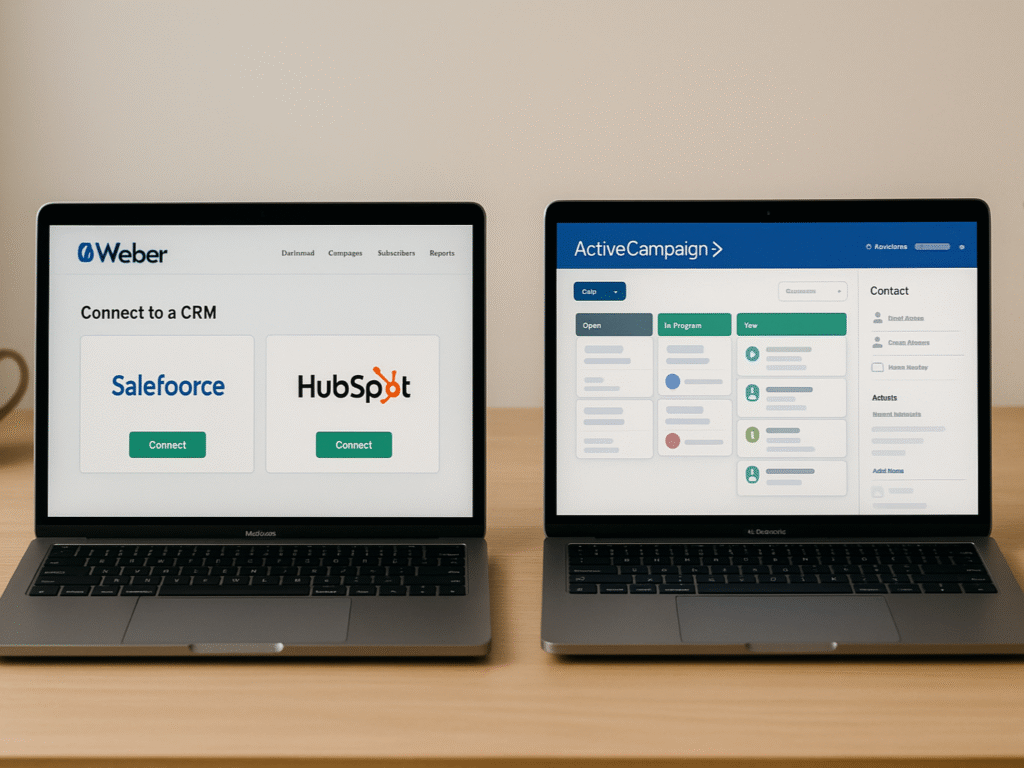
One of the most critical differences between these platforms emerges in their approach to customer relationship management. ActiveCampaign offers a comprehensive built-in CRM system, whereas AWeber provides no native CRM functionality, instead relying on third-party integrations.
1. Sales Pipeline and Deal Tracking
ActiveCampaign’s CRM stands out with its flexible pipeline management system that allows you to track your entire sales process visually. The platform enables you to create an unlimited number of pipelines, each representing a distinct sales process with customizable stages. This feature proves especially valuable for businesses with multiple product lines or services requiring distinct sales approaches.
The deal management system within ActiveCampaign’s CRM helps you monitor qualified leads as they progress through your sales pipeline. Each deal contains information about potential sales opportunities and can be linked to both primary and secondary contacts. Moreover, you can quantify the value of each deal, allowing your team to focus on the most promising opportunities.
In contrast, AWeber does not offer any built-in sales pipeline or deal tracking features. When comparing AWeber vs Mailchimp CRM capabilities, both platforms rely on third-party integrations. AWeber provides integration options with numerous third-party CRM solutions, including Salesforce, HubSpot, Agile CRM, and Zoho CRM. These integrations typically require additional setup through connection services like Zapier, which may increase your overall costs when comparing ActiveCampaign vs. AWeber pricing structures.
2. Lead Scoring and Task Automation
ActiveCampaign excels with its sophisticated lead scoring system that assigns numerical values to contacts based on their actions and engagement. This capability allows you to identify high-value contacts and opportunities effortlessly. You can establish multiple lead scoring systems to track interest in different offerings individually, consequently enhancing your sales team’s efficiency by focusing their efforts on the most promising prospects.
The platform automatically triggers email notifications and assigns tasks based on changes to the lead score. For instance, when a contact reaches a certain score threshold, you can initiate automations to send targeted information and offers. This seamless integration between lead scoring and automation creates a robust system for accelerating sales.
AWeber lacks comparable native lead scoring capabilities. While you can tag subscribers based on interests and interactions for basic segmentation, the platform cannot automatically prioritize leads based on comprehensive engagement metrics or behavioral data.
3. Contact Management and Custom Fields
Both platforms offer contact management capabilities, albeit with significant differences in depth and flexibility. ActiveCampaign provides unlimited custom fields to store contact-specific information, organized by customizable field groups for more straightforward navigation. The platform supports various field types, including text inputs, date fields, dropdowns, radio buttons, and checkboxes.
These custom fields serve multiple purposes in ActiveCampaign, enabling personalization, segmentation, and automation triggers based on changes to the fields. Furthermore, custom fields integrate directly with the CRM system, allowing for comprehensive contact profiles that support both marketing and sales activities.
- AWeber supports basic custom fields, such as name, location, and preferences.
- Lacks CRM integration, requiring third-party tools for sales tracking.
- Limited field types restrict advanced segmentation and personalization.
- Data remains isolated, making cross-functional campaigns more challenging.
For businesses seeking an all-in-one solution that bridges marketing and sales functions, the ActiveCampaign vs AWeber analysis shows that ActiveCampaign’s integrated CRM provides substantial advantages over AWeber’s disconnected approach to customer relationship management.
8 Best AWeber Alternatives for 2025 (Free & Paid Options): Exploring beyond AWeber? Discover eight powerful alternatives that might better suit your needs. Compare features, pricing, and capabilities of top email marketing platforms, including ActiveCampaign, ConvertKit, and more. Explore AWeber Alternatives
Deliverability Rates and Email Performance
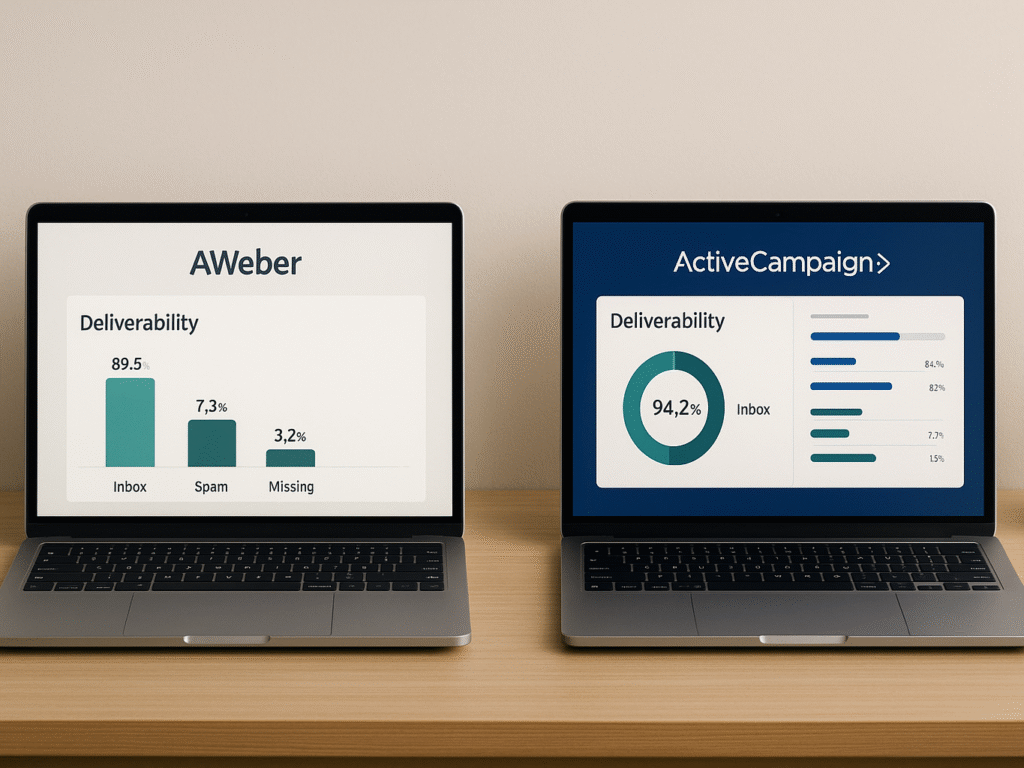
The effectiveness of your email marketing hinges fundamentally on a single factor, whether your messages reach your audience’s inboxes. Deliverability is the most critical performance metric that distinguishes effective email marketing platforms from those that are ineffective.
1. Deliverability Rate: 94.2% vs 89.5%
Independent testing by EmailTooltester reveals a substantial gap between these platforms, with ActiveCampaign scoring first place among all providers with a 94.2% deliverability rate. Similar testing patterns appear in GetResponse vs AWeber deliverability comparisons, where established providers generally outperform newer entrants. AWeber trails behind in third place with an 89.5% deliverability rate. This difference might seem modest, yet in practical terms, it means that for every 1,000 emails sent, approximately 47 more messages reach recipients with ActiveCampaign than with AWeber.
Looking at long-term performance, ActiveCampaign maintains its advantage. In continuous testing, ActiveCampaign typically achieves deliverability rates in the nineties (an average of 91.66%). In contrast, AWeber’s performance shows greater inconsistency, with some tests reporting rates as low as 78.67%.
Both platforms face challenges with specific email providers. Given these points, AWeber shows higher rates of missing emails (3.22%) compared to ActiveCampaign’s 2.70%. Regarding spam folder placement, AWeber experiences 16.44% of emails landing in spam folders, compared to ActiveCampaign’s 15.63%.
2. Spam Testing and Authentication
ActiveCampaign offers robust spam testing capabilities through its built-in “Spam Check” tool powered by SpamAssassin. This tool scans your message content before sending, identifying potential “spamminess” issues that might trigger spam filters. Upon completion, you receive either a “Passed” indication or a numerical score with suggestions for improvement.
In terms of authentication, both platforms support essential protocols, including DKIM and SPF, which verify email authenticity and help improve deliverability. ActiveCampaign additionally supports custom mail server domains and DMARC for enhanced sender validation.
3. Dedicated IP Availability
A key differentiation point exists in how these platforms handle IP addresses for sending emails. ActiveCampaign offers dedicated IP addresses for high-volume senders, primarily those with at least 100,000 active, engaged contacts. This option allows complete control over your sending reputation, but requires a consistent sending volume to maintain IP “warmth.”
AWeber, as a result, does not offer dedicated IP options, meaning all users share the same IP addresses regardless of their sending volume. This arrangement can potentially impact deliverability if other users on the same IP address engage in questionable email practices.
Fundamentally, in the ActiveCampaign vs AWeber deliverability battle, ActiveCampaign’s superior statistics demonstrate its stronger infrastructure for ensuring emails reach their intended destination. For businesses where email marketing forms a crucial revenue channel, this difference in performance could translate directly to better campaign results and higher return on investment, making activecampaign vs aweber pricing considerations secondary to deliverability performance.
AWeber vs GetResponse Comparison: Review, Features, Pricing & Deliverability (2025 Guide): Need another perspective on GetResponse? This comprehensive guide examines the strengths and weaknesses of both platforms, helping you understand which solution delivers better results for your email marketing campaigns and business growth. Read the GetResponse vs AWeber Guide.
Reporting and Analytics: Depth vs Simplicity
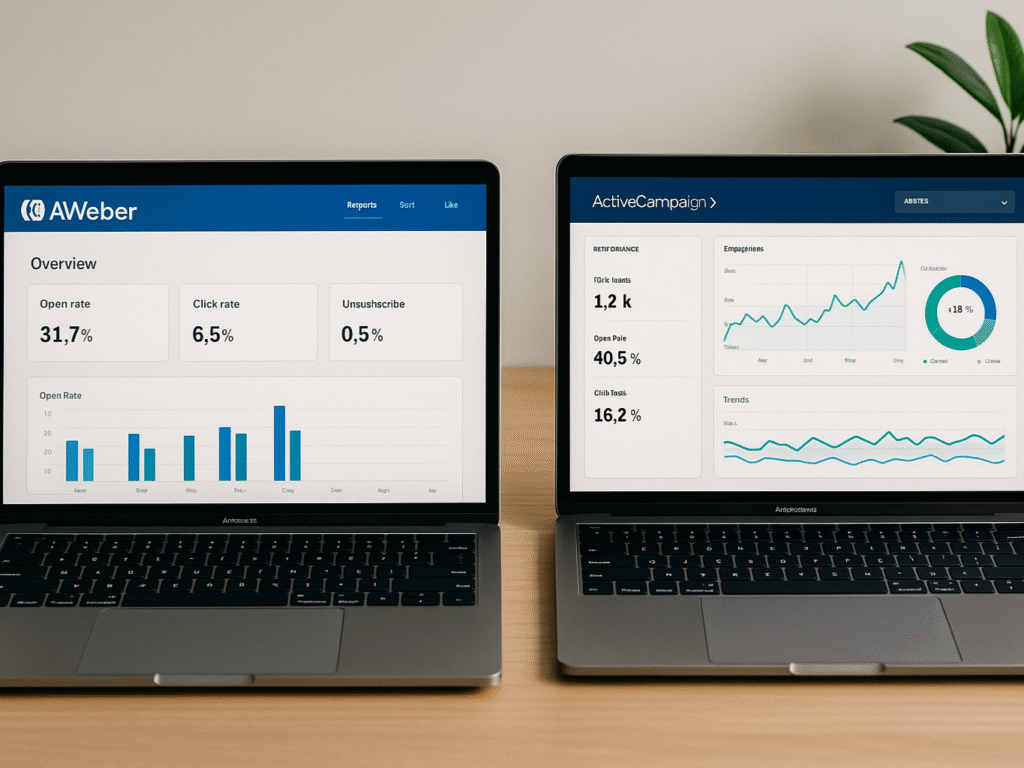
Data-driven decisions shape effective email marketing strategies, making reporting capabilities a crucial factor in the ActiveCampaign vs AWeber decision-making process. The distinction between AWeber and ActiveCampaign’s analytics reflects their broader philosophies, simplicity versus depth.
1. Campaign Performance Reports
Both platforms offer comprehensive campaign analytics, yet with notable differences in scope. AWeber provides detailed insights into A/B testing, email opens, audience demographics, and geo-tracking, even on its free plan. This accessibility contrasts with ActiveCampaign, which reserves many advanced reporting features for paid plans.
ActiveCampaign’s campaign reports deliver more profound insights, including open rates, visitor behavior patterns, click mapping, and geographic distribution. The platform’s specialized performance report aggregates data across all campaigns, showing ecommerce revenue generated, delivery metrics, and engagement rates. Fundamentally, this creates a complete view of how campaigns contribute to business growth.
One practical advantage of ActiveCampaign is its ability to track split-test email performance side by side, allowing marketers to see which message variations are successful immediately. For e-commerce store owners using WooCommerce, Shopify, or BigCommerce, ActiveCampaign’s Plus plan offers additional reporting benefits tailored to online retail.
2. Automation and Goal Tracking
ActiveCampaign distinguishes itself with robust automation goal tracking that measures marketing effectiveness. This capability allows you to monitor who progresses through your funnel and precisely where people drop off. The platform enables the monitoring of both major conversions and “micro-conversions,” such as opens and link clicks.
The goal tracking system serves dual functions: measuring performance and enabling auto-progression. It means contacts who meet specific conditions automatically move to the appropriate stages in your funnel. Each goal includes customizable elements: name, criteria, location, and action.
3. Custom Reports and Real-Time Data
Custom reporting represents perhaps the most significant analytical difference between these platforms. ActiveCampaign’s custom reporting tool allows for cross-joining data from contacts, deals, automations, campaigns, and e-commerce sources. Subsequently, this creates targeted reports answering specific business questions.
The platform refreshes custom report data once daily around 5:30 AM CST, supporting data-driven decision-making across multiple dimensions. In conjunction with standard reports, these custom views provide insights into customer behavior, campaign performance, and revenue attribution.
4. Segmentation from Reports
AWeber offers a unique capability to modify lists and create new segments directly from the reports section. This feature facilitates advanced segmentation based on campaign performance. For example, you could target subscribers who opened a specific promotion for subsequent campaigns.
Unlike other features where ActiveCampaign typically offers more depth, this list modification capability gives AWeber a distinct advantage for marketers wanting to quickly act on reporting insights without navigating between different sections of the platform.
AWeber vs Mailchimp: A Full Breakdown of Pricing, Tools & User Reviews: Comparing AWeber with another industry giant? Our comprehensive analysis compares Mailchimp and AWeber across all key factors, including deliverability, automation, pricing, and user satisfaction, to guide your platform selection. Compare AWeber vs. Mailchimp.
Integrations and App Ecosystem
Successful email marketing often hinges on how well your platform connects with other business tools. The integration capabilities of both platforms extend their functionality beyond basic email functions, creating ecosystems that support comprehensive marketing strategies.
1. Native Integrations: 970+ vs 700+
The numerical advantage favors ActiveCampaign, with its impressive array of over 970 native integrations, which markedly surpasses AWeber’s still substantial offering of approximately 700 integrations. For businesses using sales funnel builders, understanding the integration capabilities of ClickFunnels vs. AWeber becomes particularly important for comprehensive marketing automation. This difference becomes particularly significant for companies that utilize multiple specialized tools, which necessitate seamless data flow.
ActiveCampaign’s integration ecosystem connects with numerous CRM systems, website platforms, online stores, and social media sites. These connections maintain data consistency across platforms, ensuring customer information remains fresh and accurate throughout your marketing stack. Currently, the platform’s app marketplace features a mix of native and third-party apps that seamlessly integrate with services such as Salesforce, Shopify, and WooCommerce.
Simultaneously, AWeber’s integration catalog, though smaller, covers essential business tools that many small businesses and entrepreneurs typically use. It enables companies to tailor their workflows to meet specific operational needs.
2. ZapieCompatibiliCompatibility
Both platforms extend their connectivity through Zapier, effectively multiplying their integration possibilities. Zapier functions as a connector service that automates workflows between applications, eliminating the need for coding knowledge.
For ActiveCampaign users, Zapier enables connections with hundreds of external services by using ActiveCampaign as either the “trigger” or “action” in automated workflows. The platform supports numerous trigger events, including new contacts, campaign opens, and tag modifications.
AWeber users gain access to over 7,000 apps through Zapier, essentially creating a virtually limitless integration environment. Additionally, both services support Make (formerly Integromat), providing hundreds more connection possibilities. Regardless of which platform you choose, you’ll rarely find yourself unable to connect with other essential business tools.
3. E-commerce and CRM Integrations
E-commerce integrations present a particular strength for ActiveCampaign, allowing businesses to leverage real-time customer and purchase data from storefronts to trigger automations and personalize outreach. This capability proves especially valuable for online retailers seeking to create responsive marketing based on customer shopping behaviors.
For businesses requiring CRM functionality, ActiveCampaign’s direct integrations with major CRM systems help maintain accurate customer data. AWeber, lacking native CRM capabilities, relies entirely on third-party integrations to provide this functionality.
Ultimately, your integration needs depend on your existing tech stack and business requirements, making it essential to evaluate compatibility with critical tools before evaluating ActiveCampaign vs. AWeber pricing and committing to either platform.
AWeber vs Systeme.io: Full Comparison of Features, Pricing & Ease of Use: Looking for an all-in-one solution? Compare AWeber against Systeme.io to see how traditional email marketing stacks up against comprehensive business platforms offering funnels, courses, and automation in one package. Compare AWeber vs Systeme.io.
Pricing Plans and Value for Money
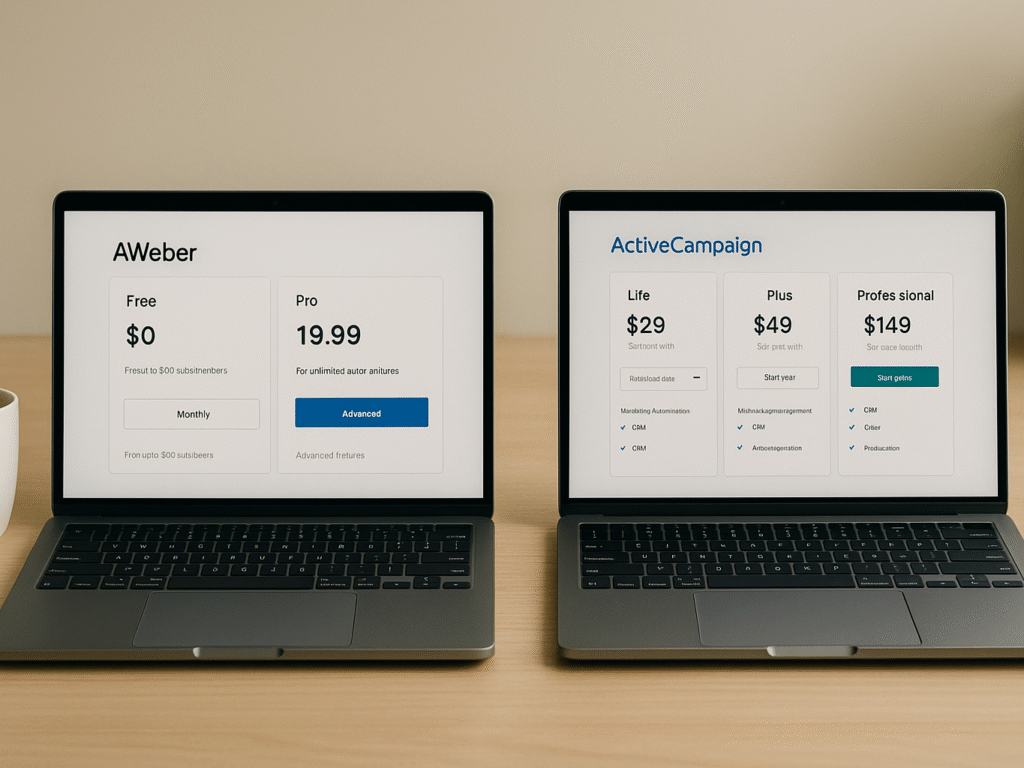
The pricing structure often becomes the deciding factor when selecting an email marketing platform. Both AWeber and ActiveCampaign offer tiered pricing models based on subscriber count, although with notable differences in their value propositions.
1. AWeber Pricing Plans Overview
AWeber structures its pricing across four distinct tiers. The Free plan supports up to 500 subscribers with 3,000 monthly email sends, one landing page, and a single automation. Moving up, the Lite plan starts at $15.00/month for 500 subscribers, offering 5,000 monthly sends, three landing pages, and three automations. The Plus plan, priced at $30.00/month for 500 subscribers, provides unlimited landing pages, automations, and 6,000 monthly sends. Finally, the Unlimited plan charges a flat $899.00/month regardless of subscriber count, making it suitable for large-volume senders.
2. ActiveCampaign vs AWeber Pricing Tiers
For equivalent contact volumes, AWeber generally costs less at lower tiers. At 2,500 contacts, AWeber Plus costs $55.00/month compared to ActiveCampaign Plus at $119.00/month. For creator-focused businesses, a pricing analysis comparing AWeber and ConvertKit reveals similar patterns, with different emphases on specific features. This pattern continues with 10,000 contacts priced at $135.00/month on AWeber versus $239.00/month on ActiveCampaign.
The primary difference stems from the depth of features. ActiveCampaign includes advanced automation capabilities, CRM functionality, and superior deliverability across all tiers. First, ActiveCampaign’s entry-level Starter plan ($15.00/month) consists of 1,000 contacts and multi-step marketing automation. Second, its Plus plan ($79.00/month) adds unlimited automation actions and triggers, as well as landing pages.
3. Free Plan vs Free Trial
Among the significant differences, AWeber offers a genuine free plan that supports 500 subscribers permanently, albeit with limitations such as basic templates and AWeber branding. In contrast, ActiveCampaign offers a 14-day free trial, limited to 100 contacts and 100 email sends per day.
4. Cost per 1,000 Contacts
Examining value per 1,000 contacts reveals AWeber’s affordability advantage. AWeber’s Lite plan costs $25.00/month for 1,000 subscribers with 10,000 monthly sends. Compared to ActiveCampaign’s Starter plan, which costs $19.00/month, it includes 10,000 monthly sends and advanced features. At higher volumes, the gap widens. AWeber charges $100.00/month for 10,000 contacts, while ActiveCampaign’s equivalent tier costs $189.00/month.
AWeber vs GetResponse Review: Features, Pricing & Deliverability Compared: Considering GetResponse as another option? Our detailed comparison examines how AWeber compares to GetResponse in terms of automation capabilities, deliverability rates, pricing structures, and overall value proposition. Read the AWeber vs. GetResponse Comparison.
Customer Support and Onboarding
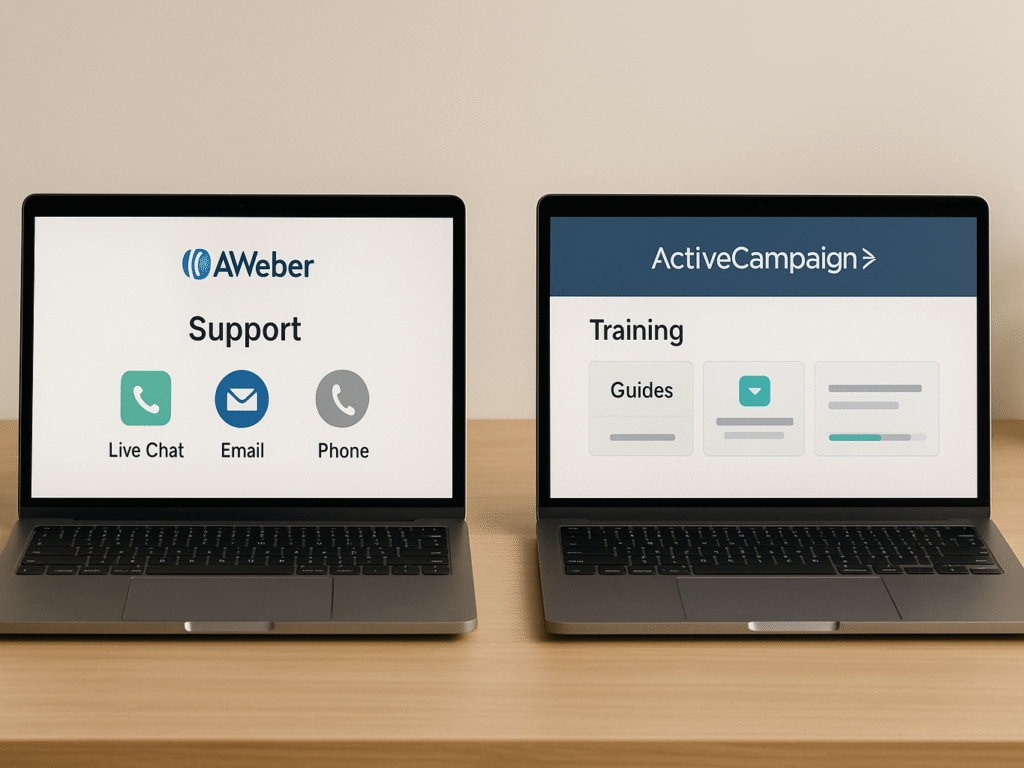
Exceptional support infrastructure often determines the success of platform adoption, extending beyond mere features and pricing considerations. Both ActiveCampaign and AWeber present distinctive approaches to helping users maximize their email marketing investments.
1. Live Chat, Email, and Phone Support
Support channel availability reveals fundamental differences between these platforms. When evaluating AWeber vs GetResponse support quality, both excel in customer service accessibility. AWeber stands out by offering proper 24/7 support across all communication channels to every user, including subscribers on the free plan. Their phone support operates during business hours (8 AM-8 PM ET USA), alongside round-the-clock live chat and email assistance.
Correspondingly, ActiveCampaign provides 24/7 live chat and email support but noticeably lacks telephone support options. Nevertheless, both services have earned praise for their quick, friendly responses to user inquiries.
2. Training Resources and Webinars
Educational resources showcase ActiveCampaign’s comprehensive approach to user development. Their extensive library encompasses detailed guides, webinars, and a community forum where users share experiences and solutions. Additionally, ActiveCampaign offers personalized one-on-one training sessions for users seeking tailored guidance.
Structured learning pathways appear throughout ActiveCampaign’s offerings, including weekly “Getting Started” webinars and the more intensive “Accelerated Onboarding” program, a three-session curriculum covering platform fundamentals (Setup/Contacts/Segmentation, Campaigns/Automations, and CRM/Reporting).
Until now, AWeber has focused more on self-service resources through its knowledge base and video tutorials, although it lacks the structured webinar program that ActiveCampaign provides.
3. Migration Services and Setup Help
Henceforth, transitioning between platforms becomes virtually painless with both services offering comprehensive migration assistance. AWeber commits to completing migrations within five business days or less, allowing concurrent account usage during the transition. Their migration package encompasses list creation, tag application, subscriber transfers, templates, forms, landing pages, and automation workflows.
Similarly, ActiveCampaign offers complimentary one-on-one migration services to subscribers of its Pro and Enterprise plans, covering email lists, templates, automations, forms, and landing pages.
Undoubtedly, both platforms recognize the importance of smooth transitions, ensuring your marketing operations continue uninterrupted during platform changes, regardless of your ActiveCampaign vs. AWeber pricing tier selection.
AWeber vs ConvertKit: Complete Feature & Pricing Breakdown: Exploring creator-focused platforms? Compare AWeber against ConvertKit to determine which platform better serves content creators, bloggers, and online entrepreneurs through a detailed feature analysis and pricing comparison. Compare AWeber vs. ConvertKit.
Final Thoughts
Choosing between ActiveCampaign and AWeber depends on your needs, tech comfort, and budget. ActiveCampaign outperforms AWeber in deliverability, achieving 94.2% compared to AWeber’s 89.5%. That’s a crucial edge, more emails in inboxes. It also offers advanced automation and CRM tools, though it has fewer templates than AWeber.
ActiveCampaign integrates with nearly 1,000 platforms and offers sophisticated reporting, making it an ideal choice for marketers who require in-depth customization and analysis. AWeber, by contrast, is more beginner-friendly with a simple interface and a generous free plan. It covers essential tools and excels in customer support, offering 24/7 access, including phone support, which ActiveCampaign lacks.
For advanced automation and sales pipelines, ActiveCampaign offers excellent value despite higher pricing. If you just need basic campaigns on a budget, AWeber is the better fit. Both offer free trials; test them and decide based on what fits your workflow, skill level, and goals. Each platform delivers solid email marketing performance.
FAQs on ActiveCampaign vs. AWeber
Q1. What is the deliverability rate of ActiveCampaign vs AWeber?
ActiveCampaign boasts a deliverability rate of 94.2%, significantly outperforming AWeber, whose rates range between 89.4% and 78.67% depending on the source. This difference can impact inbox placement and engagement, making ActiveCampaign the preferred choice for businesses focused on email performance and consistent delivery.
Q2. How do the automation capabilities of ActiveCampaign and AWeber compare?
ActiveCampaign offers over 900 pre-built automation recipes that cover complex workflows, including lead scoring, split testing, and behavioral targeting. AWeber, in contrast, focuses on basic automation, such as welcome emails, drip sequences, and subscriber tagging, making it better suited for users who need only fundamental email automation.
Q3. What are the differences in pricing plans between ActiveCampaign and AWeber?
AWeber provides a Free plan for up to 500 subscribers and a Lite plan starting at $15/month. ActiveCampaign starts at $15/month for 1,000 contacts. Still, it includes more advanced automation, CRM tools, and testing features, making it a more suitable option for growing businesses with advanced needs.
Q4. Which platform offers better customer support, ActiveCampaign or AWeber?
AWeber offers 24/7 customer support via live chat, email, and phone, making it ideal for users who prefer direct assistance. ActiveCampaign also provides 24/7 support; however, it lacks phone support, which could be a drawback for users who require immediate, voice-based assistance.